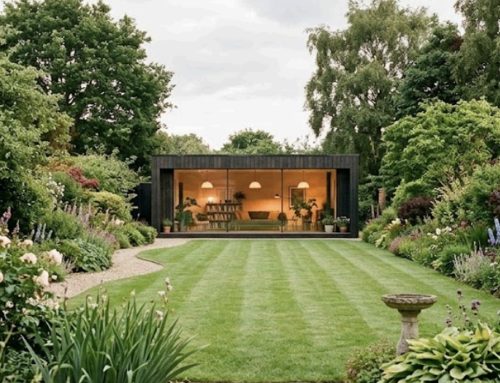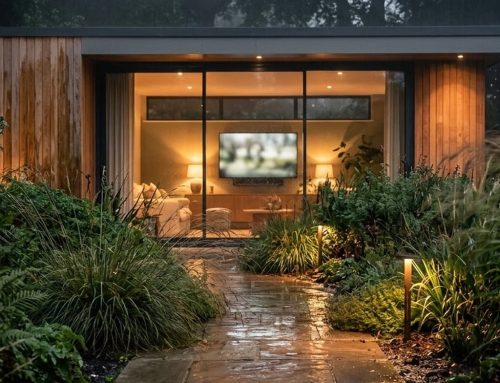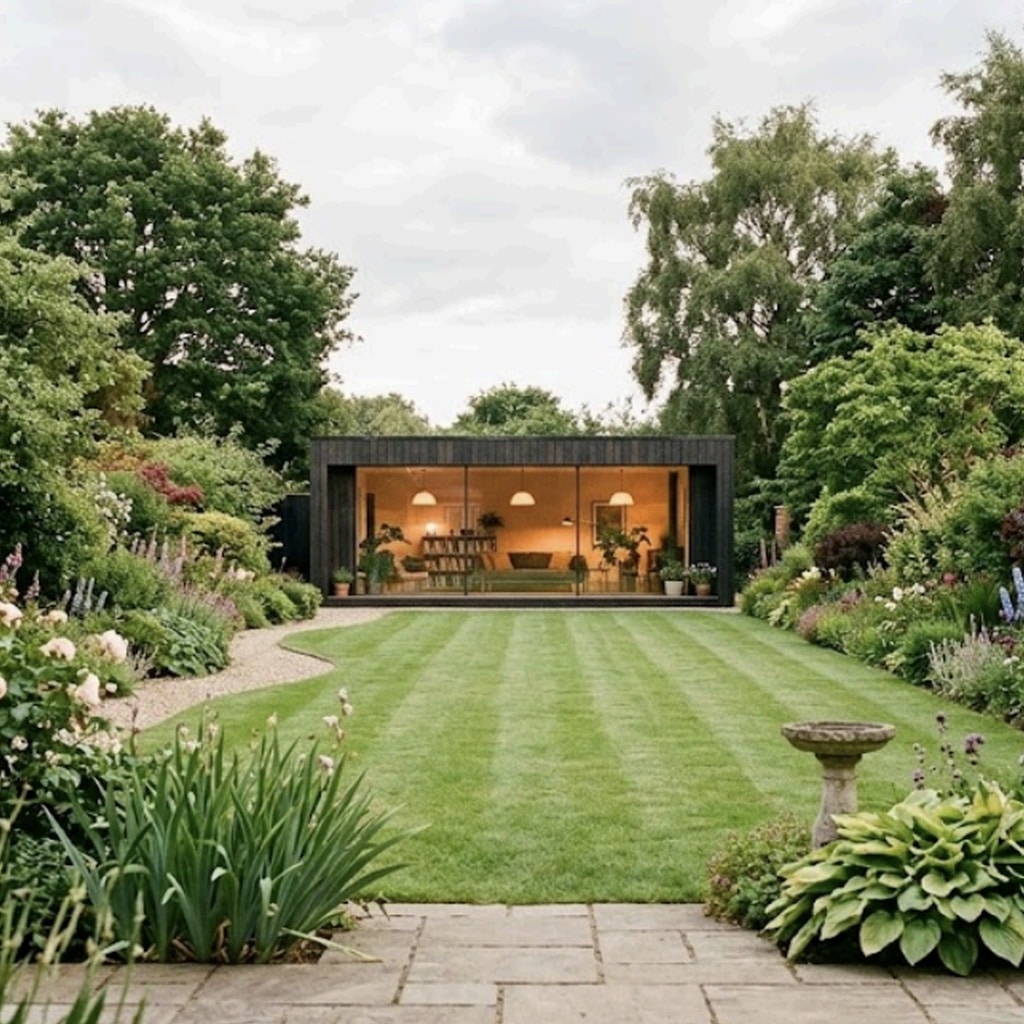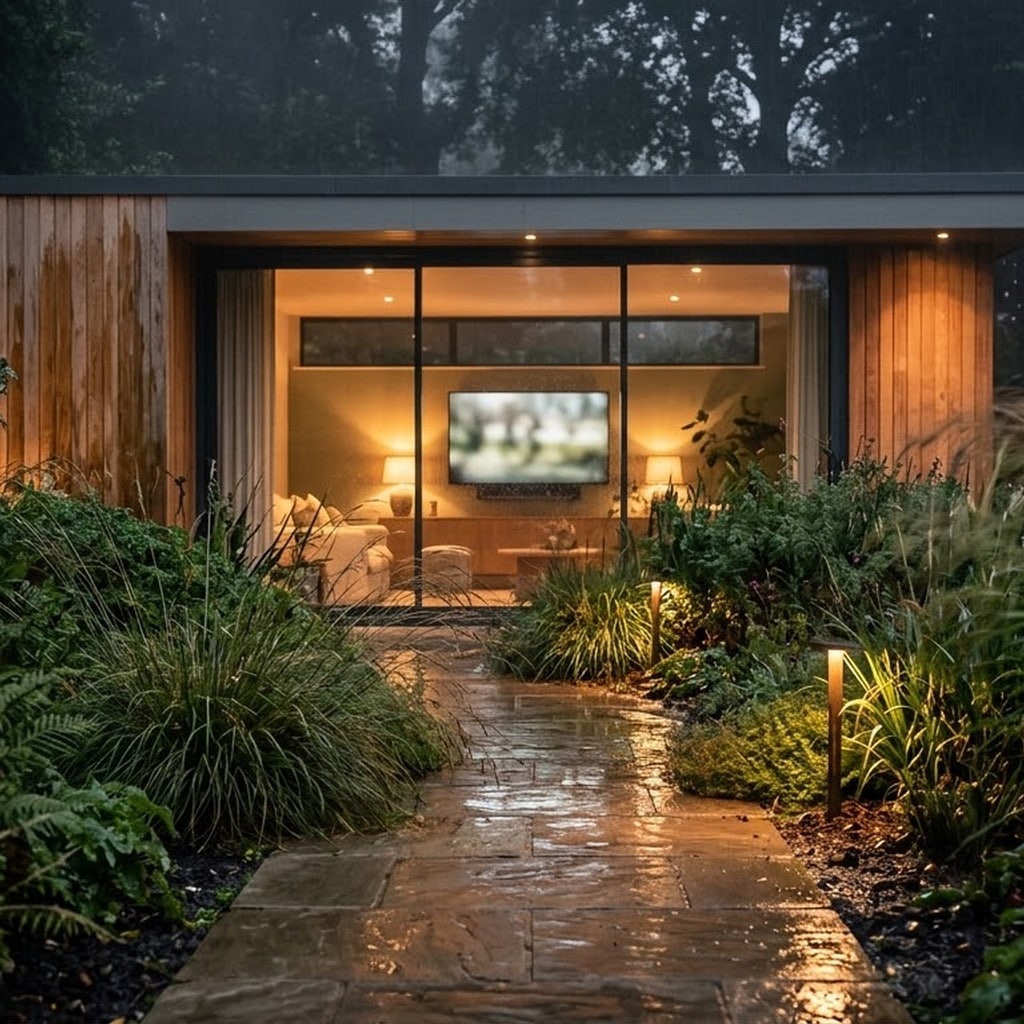
Every garden room is sold as fully insulated. Here is what that should mean, how much heat a room really needs on a freezing night, and an honest guide to the heating choices.
Every garden room company will tell you its rooms are warm in winter. Most will tell you they are fully insulated. Very few will tell you what that means in numbers, and there is a reason for that. Most garden rooms are exempt from the Building Regulations, and that includes the part that deals with insulation. So there is no legal minimum. A room with a thin layer of foam in the roof and a room built to the standard of a new home extension can both be sold, quite legally, as fully insulated.
This guide explains how warm a garden room really is, why the answer is decided long before you choose a heater, and how the main heating options compare.
The Short Answer
Yes, if it is built properly. A garden room built to today’s Building Regulations insulation standard needs less heat on a freezing night than one small electric heater gives out. A room that is merely described as insulated can need nearly twice as much, and will still feel cold near the glass.
Key Takeaways
- Most garden rooms are exempt from the Building Regulations, so there is no legal minimum standard of insulation, and “fully insulated” has no fixed meaning.
- The insulation benchmark still quoted in parts of the industry (walls 0.30, roofs 0.20, floors 0.25) is well short of the current standard for new walls, roofs and floors in a home: 0.18, 0.15 and 0.18 under Approved Document L 2021.
- In our worked example, a 21 square metre room built to the current standard needs about 0.8 kW to hold 21°C on a minus 2°C night, around half what a basic insulated build needs.
- Glass is about a tenth of the surface of a typical garden room but around 40% of its heat loss, so the glazing specification matters more than any other single choice.
- At the October 2026 price cap of 26.32p per kWh, an eight hour working day at 5°C outside costs about £1.17 with direct electric heating in a well built room, and about 39p with an air to air heat pump.
- A real wood burning stove is the one option with real regulatory weight: Part J of the Building Regulations, a carbon monoxide alarm and, in smoke control areas, a Defra exempt appliance.
Why “fully insulated” tells you nothing
A detached, single storey garden room with no sleeping accommodation is normally exempt from the Building Regulations up to 30 square metres inside. We explain those thresholds in our guide to building control. The consequence that matters here is simple: an exempt room does not have to meet Part L, the section of the regulations that sets insulation standards for homes.
That leaves the industry to set its own benchmark, and the one still most often quoted is out of date. A widely read buying guide recommends comparing garden rooms against the Building Regulations targets for new housing, which it gives as 0.30 for walls, 0.20 for roofs and 0.25 for floors.
Those were the limits of their day. They are not the limits now.
Since 15 June 2022, the 2021 edition of Approved Document L has set limiting U values for new walls, roofs and floors in a home extension of 0.18, 0.15 and 0.18, and 1.4 for windows and glazed doors. U values measure how much heat passes through a square metre of a surface for each degree of temperature difference, so lower is better. Against the old benchmark, the current wall standard lets through 40% less heat.
The other popular proof is a photograph of snow sitting on a garden room roof. It is real physics, and it is genuinely a sign of a well insulated roof. But it tells you about the roof. As the worked example below shows, the roof is not where most of the heat goes.
What we build to
Every room we build at Into The Garden Room is finished to the insulation standard the Building Regulations set for new walls, roofs, floors and glazing in a home extension, whether or not the room needs building control approval. Where a room does need approval, it is independently inspected against that standard. Where it does not, the specification is the same.
How warm is warm?
To show what the standard means in practice, we modelled the same garden room three ways. It measures about 21 square metres inside, with a 2.4 metre ceiling, a full width set of glazed doors and one window: about 9.4 square metres of glass in total, which is modest by modern garden room standards.
The only thing that changes between the three versions is the insulation and the glazing. The first is an illustrative budget build of the kind still sold as insulated. The second meets the old benchmark. The third meets today’s regulations for a home extension.
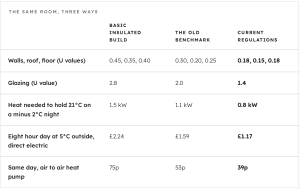
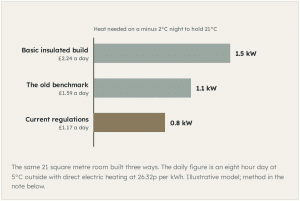
Two things stand out. The first is how little heat a properly built room needs. On a night well below freezing, it can be held at 21°C with less output than a single 2 kW heater provides, which means any sensibly chosen heating system will cope with plenty in reserve.
The second is where the heat goes. In every version, the glass accounts for around 40% of the heat lost, although it is only about a tenth of the room’s surface. That is why the glazing specification matters more than any other single decision, and why a room with a wall of glass needs better glass, not just a bigger heater.
The heating options, compared
Once the room is built properly, choosing the heating is no longer about brute force. It is about how you use the room, how quickly you want it warm, whether you also want it cool in summer, and what you want it to feel like on a winter evening. These are the options our clients choose between.
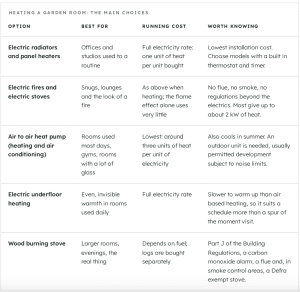
Electric radiators and panel heaters
The simplest and most common choice. Electric heaters turn every unit of electricity into a unit of heat, so they are efficient at the point of use but pay the full electricity price for every kilowatt hour. In a well insulated room that matters much less than it sounds, because the room needs so little heat in the first place. Modern panels with an accurate thermostat, a timer and app control make it easy to have the room warm before you walk in.
Electric fires and electric log burners
For many clients the appeal of a fire is the look as much as the heat. A good electric stove or inset fire gives a convincing flame with no flue, no smoke and no fuel to store, and the heater can be switched off while the flame runs on its own. Heat output is usually up to about 2 kW, which in a room built to the current standard is more than enough on the coldest night.
Air to air heat pumps, or dual air conditioning
What most people call air conditioning is, in heating mode, an air to air heat pump. It moves heat from the outside air into the room, delivering several units of heat for each unit of electricity, which makes it the cheapest option to run. It is also the only option that cools, and that matters in a room with a lot of glass, which can overheat on a summer afternoon just as easily as it can lose heat in January.
The planning position became simpler on 29 May 2025, when the rules for air source heat pumps in England were relaxed. The one metre boundary rule was removed and air to air units that also cool were brought within permitted development, subject to a noise limit. The outdoor unit still needs a sensible position, and we check that at design stage.
Electric underfloor heating
Underfloor heating gives the most even warmth of any option and leaves the walls completely clear. It responds more slowly than air based heating, so it is at its best in a room used to a regular pattern, such as a home office, rather than one you open up occasionally for an evening. It needs to be designed into the floor build up from the start.
Wood burning stoves
Nothing else feels quite like a real fire, and a stove can be a wonderful thing in a garden room. It is also the one option that brings real regulation with it. The installation must meet Part J of the Building Regulations, which covers the stove, the hearth, the flue and the air supply, and a carbon monoxide alarm is required. We have every stove installed and certified by a HETAS registered installer.
Location matters too. Much of London is covered by smoke control areas, and they exist in other towns too, so it is worth checking with your council. In a smoke control area, wood can only be burned in a Defra exempt appliance. Government guidance specifically mentions appliances with a chimney on the roof of a building such as a summerhouse, and a council can issue a penalty of up to £300 for smoke from a chimney.
Then there is size, which almost nobody mentions. Even small wood burners typically give out several kilowatts. Our worked example needs less than 1 kW on a freezing night. In a compact, well insulated room, a stove can make the space uncomfortably hot within minutes, so we only recommend one for larger rooms, alongside a smaller background heat source, and we size it to the room rather than the catalogue.
Which option for which room
Most of our rooms end up with a combination rather than a single system. A few patterns come up again and again.
A home office used every weekday. An air to air heat pump, or panel heaters on a timer, so the room is warm at nine without anyone thinking about it.
A gym or a room with a wall of glass. An air to air heat pump, for the summer cooling as much as the winter heat.
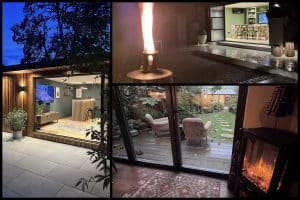
A snug, cinema room or lounge for evenings. Panel heaters for background warmth, with an electric stove or fire as the focal point.
A larger entertaining room or garden lounge. A correctly sized wood burner for the occasion, with electric heating to take the chill off on ordinary days.
Three things that matter as much as the heater
Controls. A thermostat and timer, ideally controllable from your phone, mean the room is warm when you arrive and is not heating an empty space for hours afterwards. In a well insulated room, this is where most of the saving comes from.
Ventilation and condensation. A well sealed room keeps heat in, and it keeps moisture in as well. A garden room needs controlled ventilation, and in the depths of winter a low background heat setting protects the finishes in a room that is not used every day.
Summer. The glass that brings in winter light brings in summer heat. Roof overhangs, solar control glazing and the option of cooling all deserve as much thought as the heating does.
A garden room can be every bit as warm as the house in January. Whether yours will be is decided by the walls, roof, floor and glass, long before anyone chooses a heater. Ask for the U values. Compare them against the current regulations, not the old benchmark. Then choose the heating for the way you will use the room, and the way you want it to feel. If you would like to feel the difference for yourself, our showroom at The Glasshouse Collective in Chobham is open by appointment, in every season.
Ready to bring your vision to life?
Call us on 020 8088 3572 or use the Quick form to send us a message. We’ll respond promptly with a personalised quote tailored to your project. Your perfect garden room is just a conversation away!
By Into The Garden Room |
November 7, 2026 |